Article: Percale or sateen? The honest answer.
Percale or sateen? The honest answer.
Thread count gets the headlines, but the weave decides how a bed actually feels. We wove our own cloth in Lancashire for 147 years, and we still choose every bolt with a weaver's eye.
Every bed introduces itself in the first half-second. You slide in, and the sheet is either cool and crisp, with the clean, dry rustle of a shirt just off the ironing board, or it is smooth, supple and a shade warmer, closing over you like the silk lining of a good overcoat. Neither is the better bed, and neither owes much to thread count, whatever the packaging claims. The first is percale; the second, sateen. The difference lies in how the threads cross, and once you know it you will feel it in every bed you sleep in, including other people's.
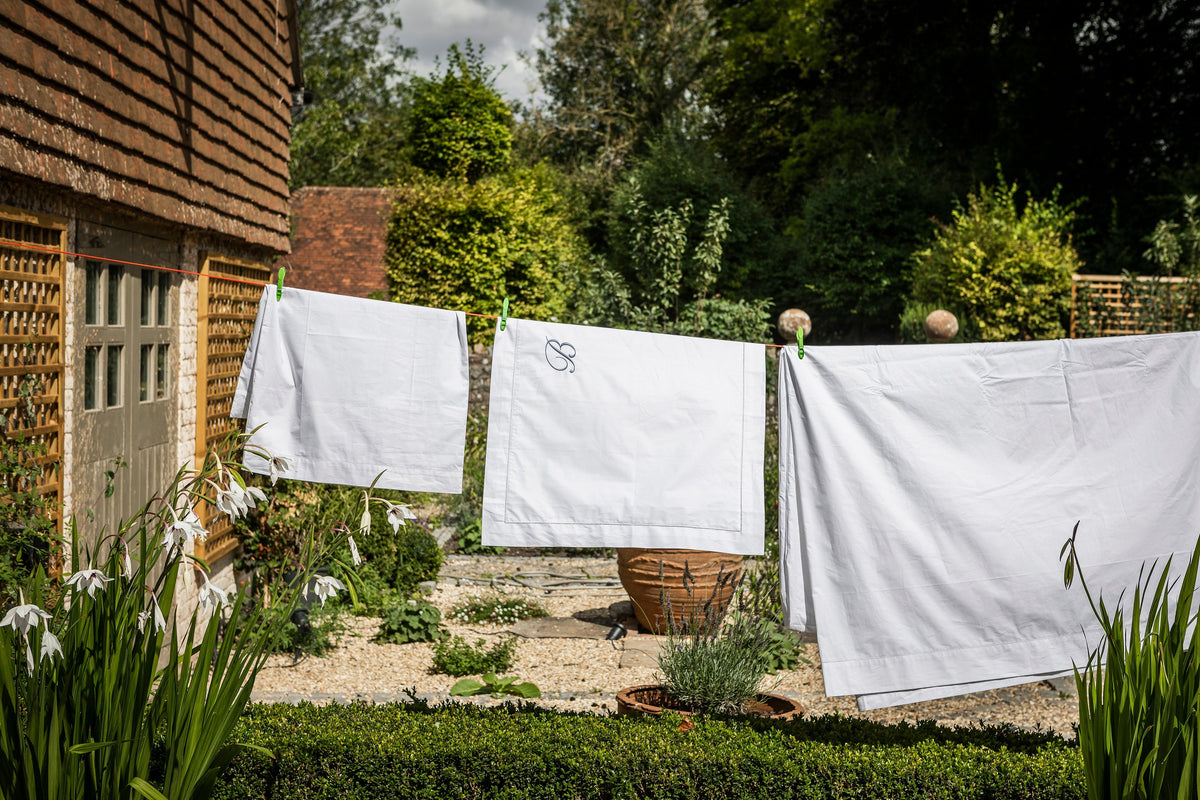
Percale is the simplest weave there is, and the least forgiving. Each thread passes over one neighbour and under the next, a tight chequerboard with nowhere for a weak yarn to hide. All that crossing makes a firm, matte cloth that breathes and stays cool to the touch, which is why percale is the standard answer for anyone who sleeps hot. Think of it as the bedroom's poplin shirt, and expect it to behave like one: it softens with every wash for years, and it creases without apology. Iron it for the hotel look, or leave it rumpled for the country-house one.
The name may come from the Persian for a rag, the kind of joke history enjoys. Ours runs from a 200-thread-count organic cotton to the 400-thread-count Egyptian cotton of our 5 Row Signature Cord.

The long float
Sateen does the opposite. Rather than crossing at every turn, each thread floats over three or four others before dipping under one, so far more of the yarn lies on the surface. Light travels along those floats uninterrupted, and that is the sheen: it owes more to geometry than to any finish. The cloth drapes rather than tents, sits closer to the body, and holds its warmth, making it the natural choice for cold feet and long winters. The word entered English in the 1830s as a variation on satin, and the cloth is precisely that: satin's structure, rendered in cotton.
The honest trade-off is that those floats are more exposed than percale's tight grid. They can snag on a ring or a cat, and in lesser cotton they pill. That is why our Classic Cord sateens are woven from extra-long-staple cotton, whose longer fibres spin into a smoother, stronger yarn with fewer loose ends to work free. Wash it as our care guide suggests, and it will hold up for years.
What the number won't tell you
Thread count is where the marketing turns murky. It measures density, not character, and it cannot tell you which weave you are buying. Because sateen crosses less often, a mill can pack in more, finer threads, so sateen numbers climb higher: ours reach 600 in the 2 Row Classic Cord and 1,000 in the 3 Row. That buys weight and a deeper lustre. It will never make sateen feel like percale. Our 260-thread-count percale and our 300-thread-count organic sateen sit 40 threads apart on paper and a world apart in the hand. We will take the number itself apart in a later piece. For now: choose the weave first, then the count.
Why Italy?
We wove our own cloth in Lancashire from 1861 until 2008. Today our percale and sateen are woven for us by long-standing partner mills in Italy, for the unsentimental reason that the finest looms for this work are there now. What we kept is the eye. A house that spent a century and a half at the loom knows good cloth the moment a bolt is unrolled on the cutting table, and has a fair idea of how it will feel in its tenth year. Every piece is then cut, sewn and finished at Butterworth Mill, where the cording goes on by hand at 28 stitches to the inch.

So, which?
Choose percale if you run warm, sleep with the window open or like a bed made with hospital corners. Choose sateen if you feel the cold, prefer drape to crispness or would rather iron less. If you share a bed with someone who runs the other way, we sympathise. The most civilised compromise is seasonal: percale from May, sateen from the night the clocks go back.
Words can only do so much for a cloth. The surest test is your own hand, so let us send you swatches of both. Feel them by daylight, then again at bedtime, and you will know which half-second you prefer. Whichever it is, the making happens in Lancashire, as it has since 1861.