What remains of Cottonopolis
Founded on the slopes of Pendle Hill in 1861, Peter Reed wove through the rise and fall of the greatest textile trade the world has known. More than 160 years on, every piece the house makes is still cut, sewn and finished in Lancashire - slowly, to order, and to a standard now kept by Royal Warrant.
Pendle Hill has a talent for weather. It stands over east Lancashire like the hull of an upturned ship, and in the middle decades of the nineteenth century the valleys at its feet filled with the architecture of an improbable idea: that this damp, stubborn corner of England might clothe the world. The dampness, as it happens, was the point - humid air keeps a cotton thread supple, and the trade prized it the way winemakers prize a slope. Raw cotton came up from Liverpool. Finished cloth went out to everywhere the shipping lines ran. Manchester, a morning's ride south, had already earned itself the name Cottonopolis; the towns beneath the hill did the weaving.
By 1891, thirty years after its founding, Springbank Mill ran 748 shuttle looms - enough to make it the second-largest weaving mill in the world, in the county then weaving for half of it. The number is easier to write than to imagine. A building of that size announced itself through the soles of the feet before it reached the ears; once inside, the noise was so entire that weavers gave up on speech and learned to read lips instead, a fluency Lancashire called mee-mawing. In a room of 748 looms, the only alarming sound was silence. Silence meant something had stopped.

The century that closed the mills
What the twentieth century did to Lancashire cotton can be told quickly, though it took sixty years. The export trade faltered after one war and broke after another; newer sheds rose in cheaper places; and the mills, buildings raised like cathedrals to a certainty that no longer held, went dark one by one, came down, or were given over to other work. The county that had clothed the world stopped weaving, almost entirely.
There was no charmed reason for Peter Reed to be the exception. The brand survived on a principle with little romance: heritage is not what a business keeps, but what it refuses to lose. And so in 1968, with the industry closing around it, Peter Reed installed the first automatic loom in the United Kingdom, modernising not as a betrayal of the old ways, but as the cost of keeping them.
We are asked, often and fairly, whether our cloth is still woven here. The honest answer - and honesty is rather the point of us - is no, not any more. The weaving trade that once surrounded the brand is gone, and the finest percale and sateen made anywhere today (percale with its cool, dry hand; sateen with its low, unhurried lustre) comes from a small number of specialist mills in Italy. We go where the best cloth in the world is woven, and we bring it home.
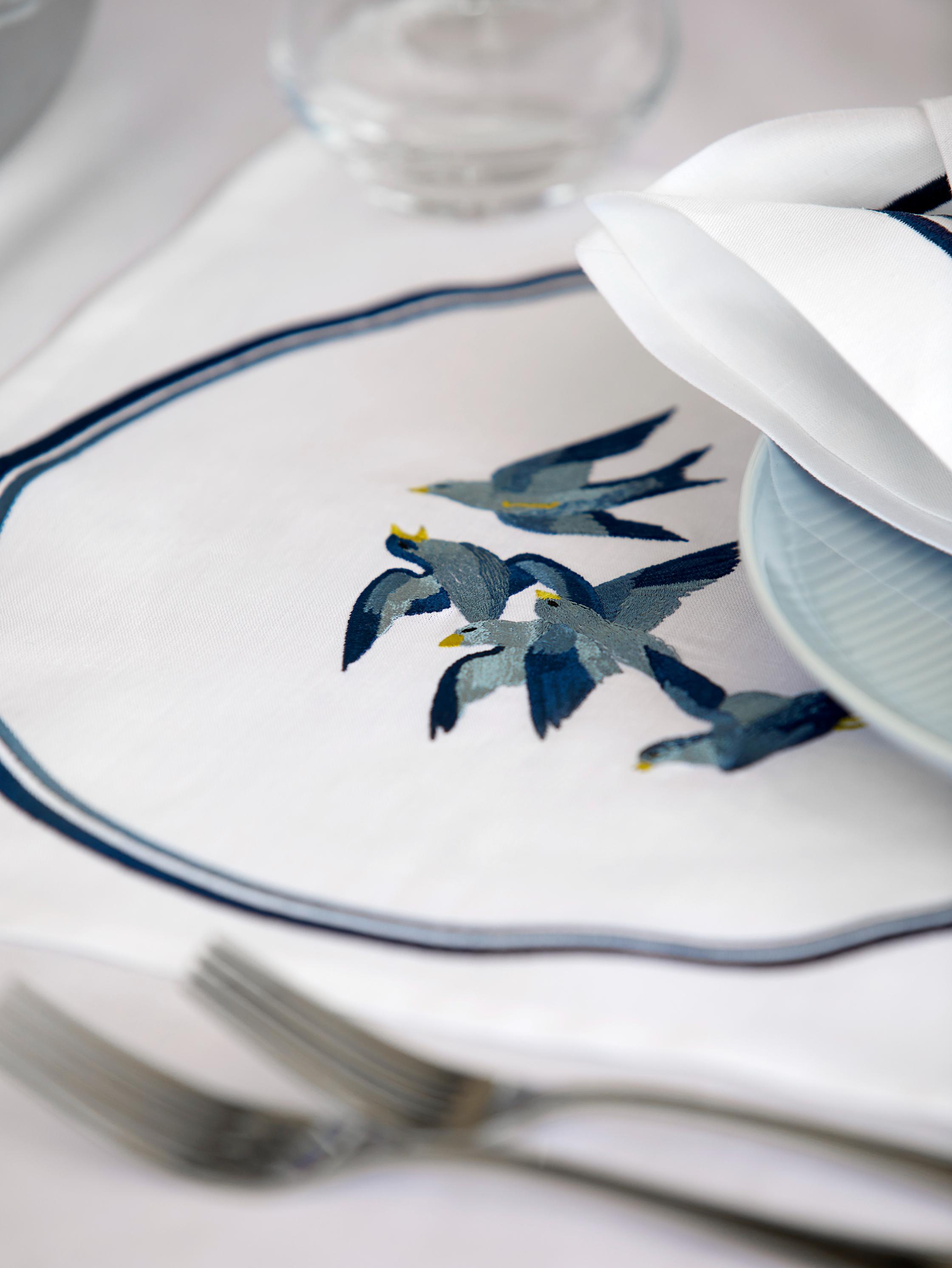
Home is Butterworth Mill, where a piece of Peter Reed linen actually becomes one. Every duvet cover, sheet and pillowcase is cut, sewn, embroidered and finished by our makers in Lancashire, made to order - which is a quiet way of saying that your linen does not exist until you ask for it. Beside the benches sits the archive: 6,000 pages of embroidery designs gathered across 160 years, hand-drawn in Madeira until the late 1940s, a library of scallops and corded rows still in working use. The 2 Row Classic Cord comes off those pages barely altered in decades. It has never needed to be.

By Appointment
The standard has a witness. In 2008, Her Majesty Queen Elizabeth II granted Peter Reed her Royal Warrant; in 2024, the brand was appointed 'Manufacturers of Bed Linen to His Majesty King Charles III'. A warrant photographs like a trophy and behaves like an audit: it recognises goods actually supplied, over years, to a Household free to choose anyone, and it is held only as long as the standard holds. It's reviewed, renewable, revocable. It remains the one endorsement we could not have written ourselves.
So when we say that Lancashire is in every piece of Peter Reed linen, we do not mean the label. We mean the temperament of a weaving county with nothing left to prove: patience, plain speech, a suspicion of shortcuts, and the habit of finishing the underside of the work as carefully as the face of it - because someone, eventually, will look. The mills are mostly gone. The standard did not go with them.